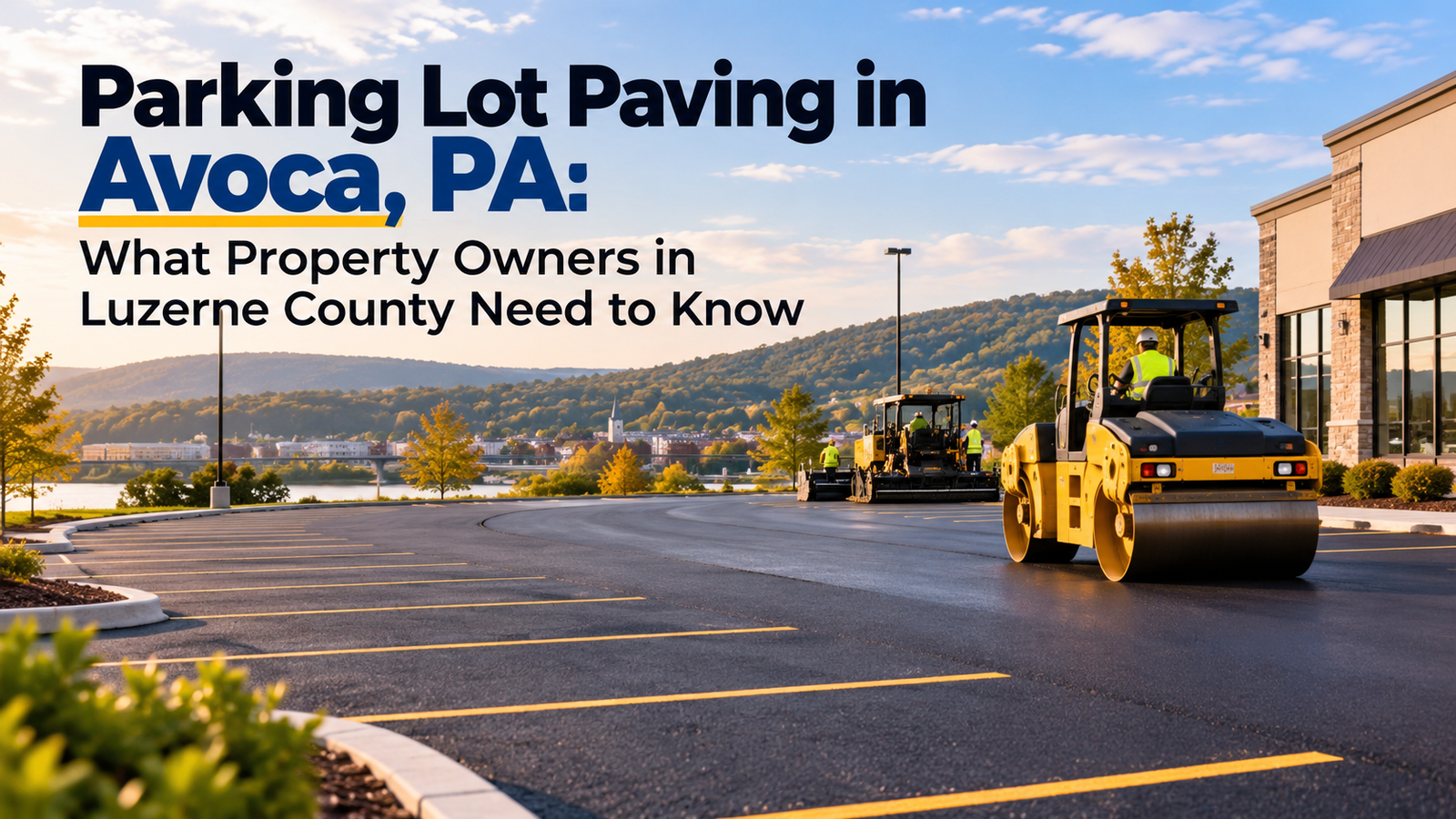
Parking Lot Paving Avoca in the Wyoming Valley carries specific considerations that reflect the region’s climate extremes, subsurface conditions, and the regulatory framework governing construction in Luzerne County and Avoca Borough. Whether the project is a new commercial development, a resurfacing of an aging retail lot, or a full reconstruction of a deteriorated parking area, the decisions made during design and construction directly determine how long the pavement performs and how it manages the stresses of northeastern Pennsylvania winters.
Parking Lot Design in a Cold Climate
The design of a parking lot in northeastern Pennsylvania must prioritize freeze-thaw durability from the first decision point: subbase material selection. Granular material used in the base course must be free of frost-susceptible fines materials with a significant clay or silt fraction that hold water and expand when frozen. PennDOT specifications for granular base material restrict the percentage of passing fines in the aggregate to prevent frost susceptibility.
Cross-slopes must be steep enough to prevent water from ponding on the surface. Ponded water in a parking lot freezes in place, becomes a slip hazard for pedestrians and vehicles, and more critically infiltrates through any surface cracks to reach the base course where it can cause the most structural damage. A minimum 2 percent surface slope is standard; in areas where snowmelt runoff is expected to be concentrated, steeper slopes or drainage channels may be appropriate.
Snow removal operations impose loads on parking lot surfaces that are different from vehicle loads. Plow blades drag across the surface and can catch at pavement joints, edges, and patches. Lots in Wyoming Valley need to be designed with smooth transitions at all elevation changes, and any patch repairs need to be tapered at the edges to prevent plow blades from catching and lifting the repair material.
Pavement Structure for Luzerne County Conditions
The structural design of a commercial parking lot in Avoca must account for the seasonal variation in subgrade bearing capacity. In spring, when frost is melting out of the soil, the subgrade can be significantly weakened as water is released from thawing ice lenses. During this spring thaw period, pavement that appeared stable in fall may deflect visibly under traffic loads, and heavy vehicles including loaded delivery trucks can cause ruts and base damage that would not have occurred in frozen ground conditions.
Pennsylvania’s weight restriction program, administered by PennDOT, applies reduced weight limits to state roads during spring thaw. While these weight limits apply to public roads rather than private lots, the underlying principle that spring thaw dramatically reduces pavement bearing capacity is equally applicable to private commercial parking areas. Scheduling heavy deliveries or construction equipment movement to avoid the peak thaw period protects the pavement investment.
Typical commercial lot pavement sections in the Wyoming Valley include 3 to 4.5 inches of asphalt over 8 to 12 inches of compacted aggregate base for standard passenger vehicle lots, with heavier sections in truck-traffic zones. Full-depth reclamation (FDR) of existing pavement pulverizing both the old asphalt and the base to create a blended stabilized base is increasingly used on commercial reconstruction projects as a cost-effective way to improve base quality while recycling existing materials.
Drainage Infrastructure in Parking Lots
Luzerne County sees significant precipitation approximately 38 inches of annual rainfall plus 40 to 50 inches of snow and drainage infrastructure in parking lots must handle both rain events and snowmelt. Catch basins in commercial lots should be sized for the design storm event (typically a 10-year storm event for private lots under most municipal stormwater ordinances in the county) and should be located at low points in the drainage pattern where runoff naturally concentrates.
Inlet grates and frames in parking lots require periodic inspection because they are subject to loading from vehicles driving over them and can settle, heave, or corrode over time. A sunken inlet creates a drainage low point that also becomes a pavement stress concentration, accelerating cracking around the structure. Inlet replacement or adjustment is a common element of parking lot resurfacing projects in the region.
Pennsylvania municipalities must comply with NPDES Phase II stormwater regulations for municipal separate storm sewer systems (MS4). Commercial property owners adjacent to MS4 areas may be subject to requirements related to illicit discharge, construction site runoff control, and post-construction stormwater management. The Luzerne County Conservation District provides technical assistance and plan review for stormwater compliance.
ADA Accessibility in Wyoming Valley Commercial Lots
The 2010 ADA Standards for Accessible Design apply throughout Pennsylvania, and the Pennsylvania Human Relations Act provides parallel state-level requirements. Accessible parking spaces in commercial lots must meet the quantity requirements of the ADA (1 accessible space per 25 total spaces up to 100 total, scaling above that) and must be positioned on the shortest accessible route to the building entrance.
In northeastern Pennsylvania’s context, accessible routes through parking lots must also account for snow and ice maintenance. Accessible spaces that are plowed last or that collect runoff from the rest of the lot become unusable for people with mobility limitations during winter weather. Design that considers winter maintenance locating accessible spaces where they can be cleared early, using drainage slopes that move meltwater away from accessible routes is part of responsible accessible facility design.
Materials and Specifications for Winter-Durable Pavement
Hot mix asphalt placed in cold weather requires careful temperature management. PennDOT Publication 408 specifies minimum ambient and surface temperatures for paving asphalt cannot be placed when the air temperature is below 40°F and falling, or when the surface is frozen, wet, or contaminated. The paving season in Avoca effectively runs from May through October, with the shoulder months requiring monitoring of conditions and shorter paving windows on cooler days.
Winter paving is possible but requires warm mix asphalt technology and careful attention to haul distances and compaction windows. Most commercial parking lot paving in northeastern Pennsylvania is planned for the warmer months to ensure proper compaction and bonding.
Frequently Asked Questions: Parking Lot Paving in Avoca
What is spring weight restriction and how does it affect parking lot construction?
Spring weight restrictions reduce permissible vehicle weights on state roads during the thaw period typically February through April when subgrade bearing capacity is reduced by frost melt. While these restrictions directly apply to public roads, contractors moving heavy equipment or receiving material deliveries to construction sites must plan routes and schedules around these restrictions. Overloaded vehicles on restricted roads face fines.
How often do parking lots in northeastern Pennsylvania need to be resurfaced?
Given the region’s harsh winters, commercial parking lots in the Wyoming Valley typically require resurfacing every 15 to 20 years if maintained properly. Lots that receive consistent crack sealing and are cleared of snow promptly preventing prolonged moisture infiltration last toward the upper end of that range. Neglected lots may need resurfacing within 10 years.
Can parking lot paving proceed in the fall?
Paving can continue through October in the Wyoming Valley, with monitoring of weather conditions. The minimum ambient temperature threshold and the rapid cooling of asphalt in cold weather compress the compaction window, requiring the paving crew to work efficiently. As temperatures approach freezing at night, the risk of adhesion problems and inadequate compaction increases. November paving is generally avoided.
What permits are needed for a commercial parking lot project in Avoca Borough?
Projects involving new impervious surface construction typically require an earth disturbance permit from the Luzerne County Conservation District when disturbance exceeds one acre. Avoca Borough may require a local building or grading permit depending on project scope. Connections to state roads require a PennDOT Highway Occupancy Permit. Projects near the floodplain may require a floodplain development permit from the municipality.